The Table That Tells You Everything
Don Ricardo Sánchez invites Stefan and Sophie for dinner at his family's estate. The food is extraordinary, the conversation is careful, and Sophie finds herself watching two young Ngäbe women carry dishes in and out of a room where they will not sit down. She doesn't have the words for what she's seeing yet. She writes it down anyway.
Dinner with Don Ricardo and Doña Carmen. The table is beautiful, the food is extraordinary, and Sophie keeps looking at the door to the kitchen.
The Invitation That Was Not a Question
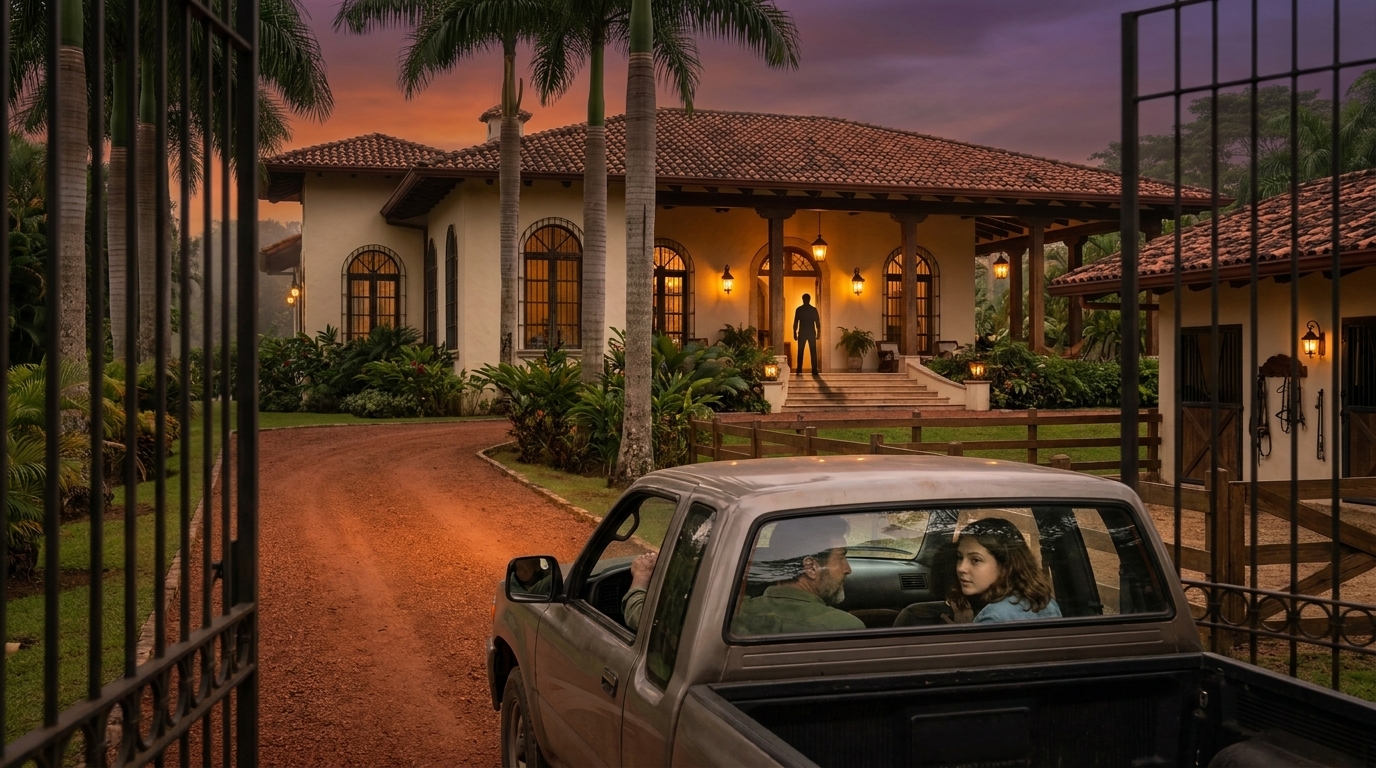
The invitation arrived the evening after Valentina took me on the forest trail. Papa came in from the terrace and said: “Don Ricardo wants us for dinner tomorrow. He says his wife insists.”
I said: “Is that good?”
He said: “You do not decline Doña Carmen.”
This was not, I gathered, because Doña Carmen was frightening. She was not frightening, as it turned out — she was warm and precise and the kind of woman who fills a room without raising her voice. It was that an invitation from the Sánchez family was a different category of social interaction from the finca’s daily rhythms. The finca was Papa’s life: plain, practical, a man’s house with horse feed in the storage room and a fan that rattled. The Sánchez estate was something else. I didn’t know what yet.
“What do I wear?” I asked.
Papa considered this. “Something clean.”
Valentina had said the same thing when I texted her: No te preocupes. Son mis padres, no el Palacio de Buckingham. Don’t worry. It’s my parents, not Buckingham Palace.
I wore my only decent t-shirt, the dark blue one without any writing on it, and my cleanest shorts, and my sneakers that I had scrubbed the mud from the evening before. Papa wore jeans, a collared shirt, his leather boots. We looked, I decided, like two people who had tried. That was going to have to be enough.
The drive was twenty minutes north of the finca. The road improved as we went — pot-holed laterite track gave way to gravel, then to paved asphalt, then to a long straight lane bordered by young palms. The gate was white rendered concrete, iron, standing open. A lantern on each post. The driveway stretched ahead toward a house that was, compared to Papa’s finca, extremely serious about being a house.
“Tile roof,” I said.
“Don Ricardo restored it ten years ago,” Papa said. “Original foundations. The family has been on this land since his grandfather.”
A man was standing on the veranda steps. Stocky, silver-streaked hair and a mustache that meant it. Cowboy boots, even at dinner. He spread both arms wide when he saw the truck.
“Stefan! Bienvenidos.”
Don Ricardo Sánchez Herrera
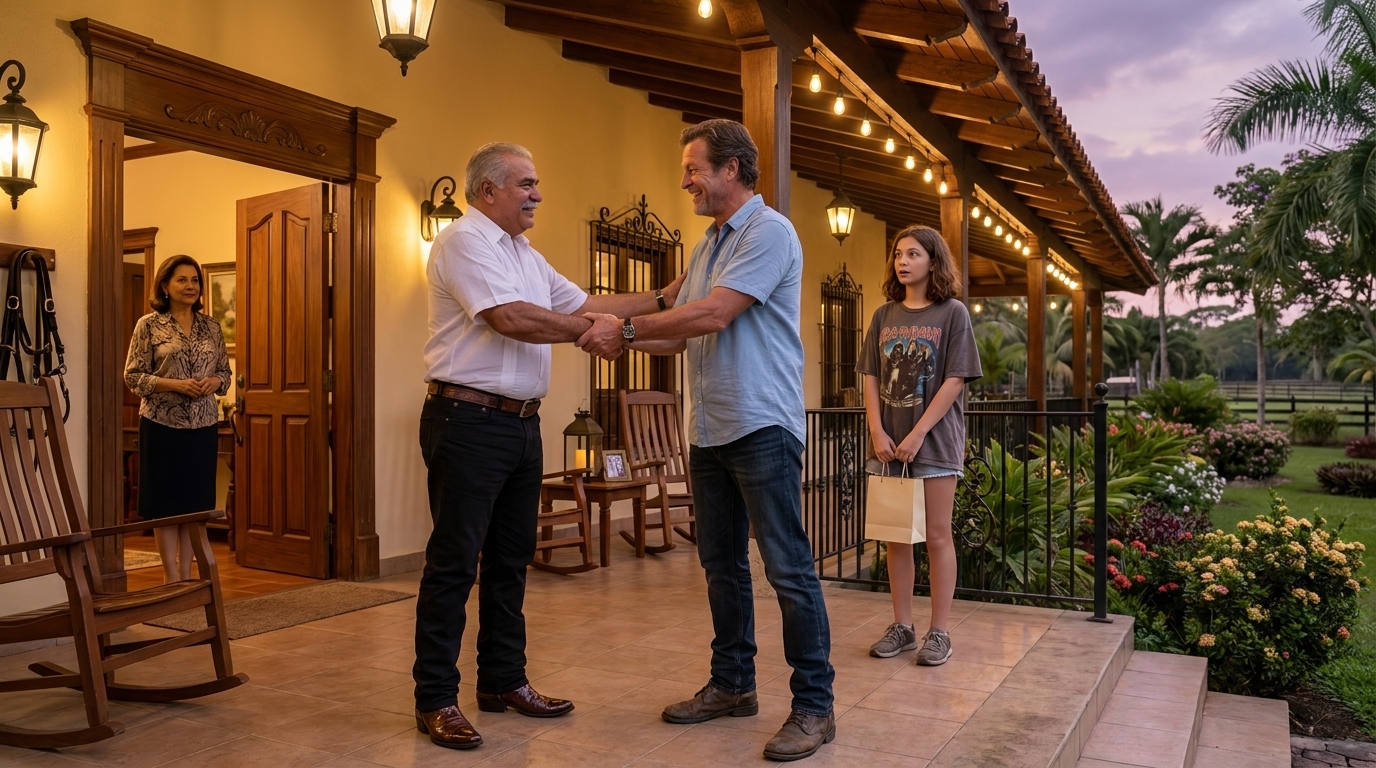
There are people whose handshakes say I am pleased to meet you and people whose handshakes say I have decided you are already trustworthy and if I am wrong I will revisit this.
Don Ricardo Sánchez Herrera had the second kind.
He shook Papa’s hand with both of his, three good pumps, then turned to me and did something I did not expect: he offered me the same handshake. Not the brief touch-the-fingers-and-smile handshake some adults give teenagers. A real handshake, looking me in the eye, one firm grip. “La famosa Sophie Richter. Bienvenida a mi casa.”
Famous how? I still don’t know. I said, “Muchas gracias, señor,” which was approximately the limit of my polished Spanish, and he looked satisfied.
He was not what I expected from a wealthy landholder. He was shorter than I’d imagined. His guayabera shirt was plain white linen. His cowboy boots were not decorative — they were working boots, worn and polished, boots that had been inside stables. He smelled faintly of leather and something herbal, like the underside of a saddle on a warm day.
“My father thinks in horses,” Valentina had told me once on the trail. “Everything he judges, he judges the way you judge a horse. Is it honest? Does it work hard? Does it give what it has?” She had paused. “This is sometimes inconvenient for his children.”
Doña Carmen appeared in the doorway behind him. Small, precise, gray-streaked hair in a chignon that had survived whatever the day had thrown at it. A dress in pale blue, gold earrings, an emerald ring on her right hand that caught the Edison-bulb light and held it. She came down the veranda steps and took my hands in both of hers.
“Bienvenida, mi amor.” She looked at me very carefully, with the eye of someone doing something other than being polite. Then, to Papa, in English: “She has your eyes. You did not tell me she had your eyes.”
Papa opened his mouth. Nothing came out.
“Come inside,” Doña Carmen said, already turning, the matter resolved. “Edilma is setting the table.”
The Room
I have been in apartments in Wilmersdorf and offices in Mitte and the homes of my mother’s friends who teach or work in publishing and think of themselves as well-off. I have not been in a room like the Sánchez dining room.
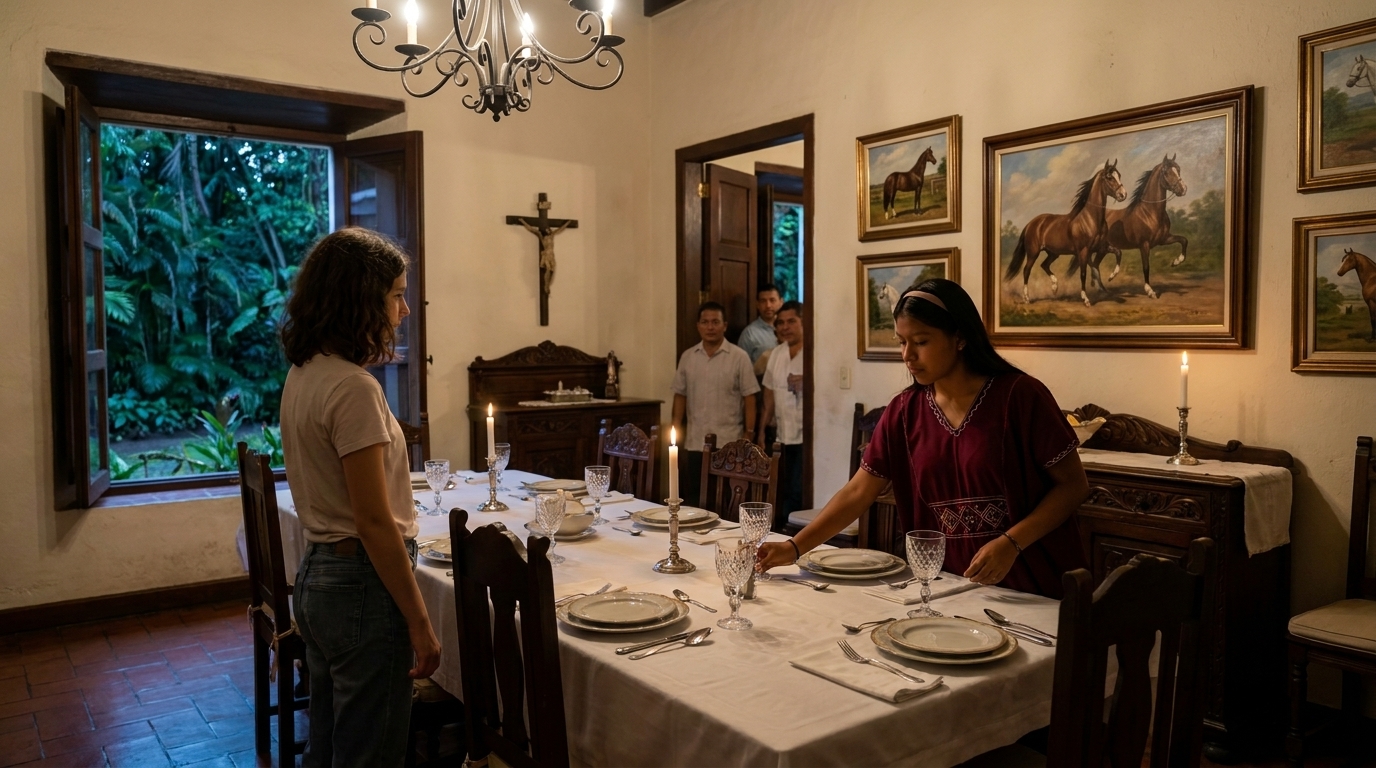
It was not extravagant. It was not dripping with things. It had a heavy wooden table, eight chairs with leather seats and high backs, white linen, flowers in a wide ceramic vase. A chandelier of wrought iron. Paintings on the walls — horses, mostly. A crucifix above the sideboard. An open window giving onto a dark garden where something was blooming, filling the air with a sweetness I couldn’t name.
What it had was depth. The feeling that this room had been doing this for a long time. The table had scratches from other dinners. The paintings had been chosen carefully and hung by someone who knew where they wanted them. The crucifix was not a decoration — it was a thing someone had brought home from somewhere and put on the wall because it mattered to them.
I stood near the window and looked at a painting of two Peruvian Pasos in full paso: long manes streaming, the distinctive outward curl of the termino in the front legs. The artist was not famous — there was no signature I could read — but they had watched these horses the way you have to watch something to paint it. Not from a photograph. From a field.
“You recognize them?” Don Ricardo appeared beside me.
“The gait,” I said. “Valentina showed me.”
He nodded, looking at the painting. “My father painted that. He could not draw a straight line. He could paint a horse perfectly.” He said this without any particular emotion, the way you say the well is behind the barn — a fact of the landscape. “Come. Sit.”
I noticed the young woman placing a final glass at the end of the table.
She was perhaps twenty. Her hair was pulled back under a dark headband, and she wore a long dress in a deep wine red with an embroidered band of geometric pattern around the hem and waist — not a uniform, not the plain cotton I might have expected, but something clearly her own. She moved with the concentration of someone doing precise work — each glass at its exact distance from the plate, each cloth napkin folded identically. She did not look up.
“Gracias, Yariela,” Doña Carmen said, passing with a basket of bread.
Yariela nodded, still not looking up, and went back through the door to the kitchen.
I looked at the door after she had gone through it. The dress had been remarkable. I didn’t know why yet.
I sat down where I was told.
The Dinner
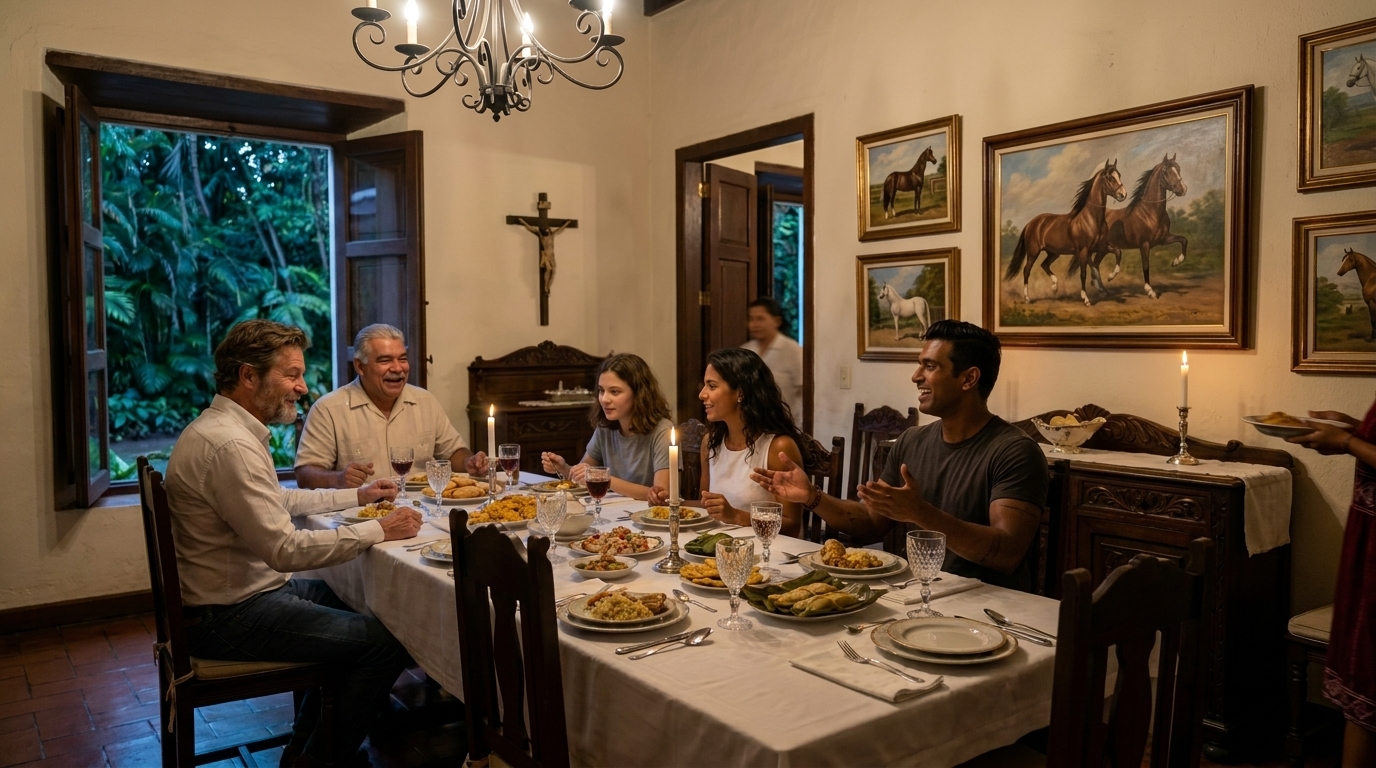
There were six of us: Don Ricardo and Doña Carmen, Papa and me, Valentina, and a late arrival — Mateo, Valentina’s brother, who blew in through the door twenty minutes after we sat down still dusty from a trail ride, kissed his mother on the cheek, shook my hand with the same firm directness as his father, announced that the fence on the back quadrant was fixed, and sat down without apology.
He was louder than Don Ricardo. Broader. Twenty-six years old and comfortable in the way of someone who has never needed to calculate whether he belongs somewhere.
The food arrived in stages, carried out by Yariela and a second young woman Doña Carmen called Edilma. They moved between the kitchen and the dining room without sound — placing dishes in the center of the table, removing them when finished, refilling water glasses before anyone noticed they were empty.
The food was magnificent. Ceviche first: corvina in lime, red onion, ají chombo cut fine, a pile of patacones on the side. Then arroz con pollo, properly made, the rice golden with sazón, the chicken tender off the bone. Then tamales in banana leaves — dark, dense, savory, each one a small architecture. Ensalada de feria: beets and potatoes and green beans dressed with vinegar. Bread from a basket that was replenished once without being asked.
I ate everything.
“She eats,” Don Ricardo observed, approvingly, the second time I reached for the tamales.
“She eats,” Papa confirmed, with an expression I couldn’t categorize.
“Stefan, you have been starving this girl,” Doña Carmen said, in the tone of someone settling a matter.
“Rosa feeds her,” Papa said.
“Then Rosa has been compensating for you,” Doña Carmen said. Papa accepted this.
The conversation moved in the way of a table where everyone knows each other and has things to say. Don Ricardo asked Papa about the horses: how was Reina’s weight, had Esteban checked the fence on the eastern side, had he noticed the change in Moro’s left front hoof? Papa had noticed. They discussed this in Spanish that was too fast for me, but Valentina caught my expression and said quietly, “Reina is good. Papa is just thorough.”
Mateo asked me about Berlin. Had I been to the Berghain? (I was sixteen. He watched my face and laughed. “In fifteen years.”) Did I know how to drive? (No.) Did I know how to ride a horse? (Valentina looked at him. “She can paso.” He raised his eyebrows with genuine respect.) Did I know how to build a fire on a beach? (“We’re going Saturday,” he announced, to the table in general. “Everyone. Non-negotiable.”)
Valentina translated the things I missed. I translated nothing — I had nothing to offer in that direction — but I understood more than I had expected. A week of Spanish immersion had done something to my comprehension. I couldn’t speak it, but it was beginning to separate into sounds that meant things and sounds that connected them.
Doña Carmen asked me, in careful English, what I intended to study. I told her computer science. She considered this. “Like your father.” I said: not exactly like my father, but influenced by him. She nodded as if I had given the correct answer to a question she had been holding.
Yariela appeared at my left shoulder with a pitcher. My water glass was refilled before I had noticed it was low. I turned to thank her. She was already moving toward the other side of the table.
What I Noticed and Did Not Say
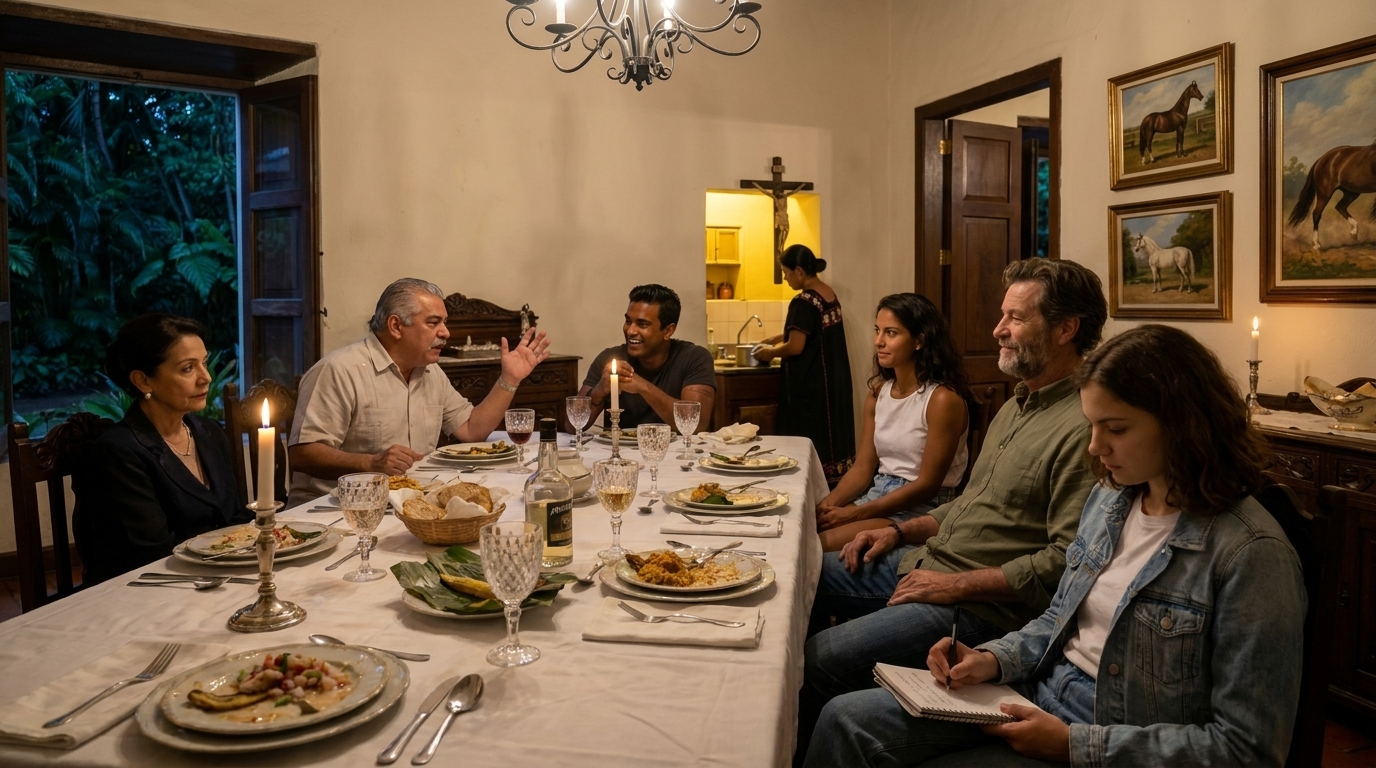
I had a notebook with me. I always have a notebook. Papa’s habit, though I’d never told him that.
Under the table, with the conversation flowing around me in two languages, I opened it and wrote: Who pours the water.
That was all. I didn’t know yet what it meant, or what to do with it, or whether it meant anything at all beyond the obvious. Yariela and Edilma had served the whole meal, carried every dish, refilled every glass, cleared every plate. They had done it with skill and quiet and without complaint and without sitting down. The table they had set so carefully held six people who ate at it. They were not six of those people.
I had noticed the same thing at the airport in Tocumen. The women who swept the floors while I walked past them in my denim jacket and my dead-inside airport expression. The boy who carried Don Ricardo’s luggage — I invented a scenario where Don Ricardo had once traveled and needed luggage carried — and the difference between that boy and the boy who might someday have luggage. I was inventing. But I was noticing.
I am sixteen. I know the words inequality and class structure and colonialism because they appear in social studies textbooks in a font designed to make them look manageable and theoretical. I do not know what they look like in a room. I did not know until I watched Yariela fill my glass and return to the kitchen and come back out and fill the next glass and never once look up at the conversation going on above her head.
I didn’t know enough to say anything smart about it. I didn’t try. I just wrote it down.
Doña Carmen caught me writing. She had eyes that caught things. She said nothing, but she gave me a look that wasn’t disapproval — something more like recognition. As though she had seen this moment before: someone from outside sitting at her table and noticing.
I closed the notebook.
Dessert arrived: tres leches cake, dense with cream, dusted with cinnamon. Edilma set it in the center of the table and Doña Carmen cut it and served. The first piece went to me.
“Eat,” Doña Carmen said. Not unkindly. “Everything is better with tres leches.”
I ate.
The Veranda After
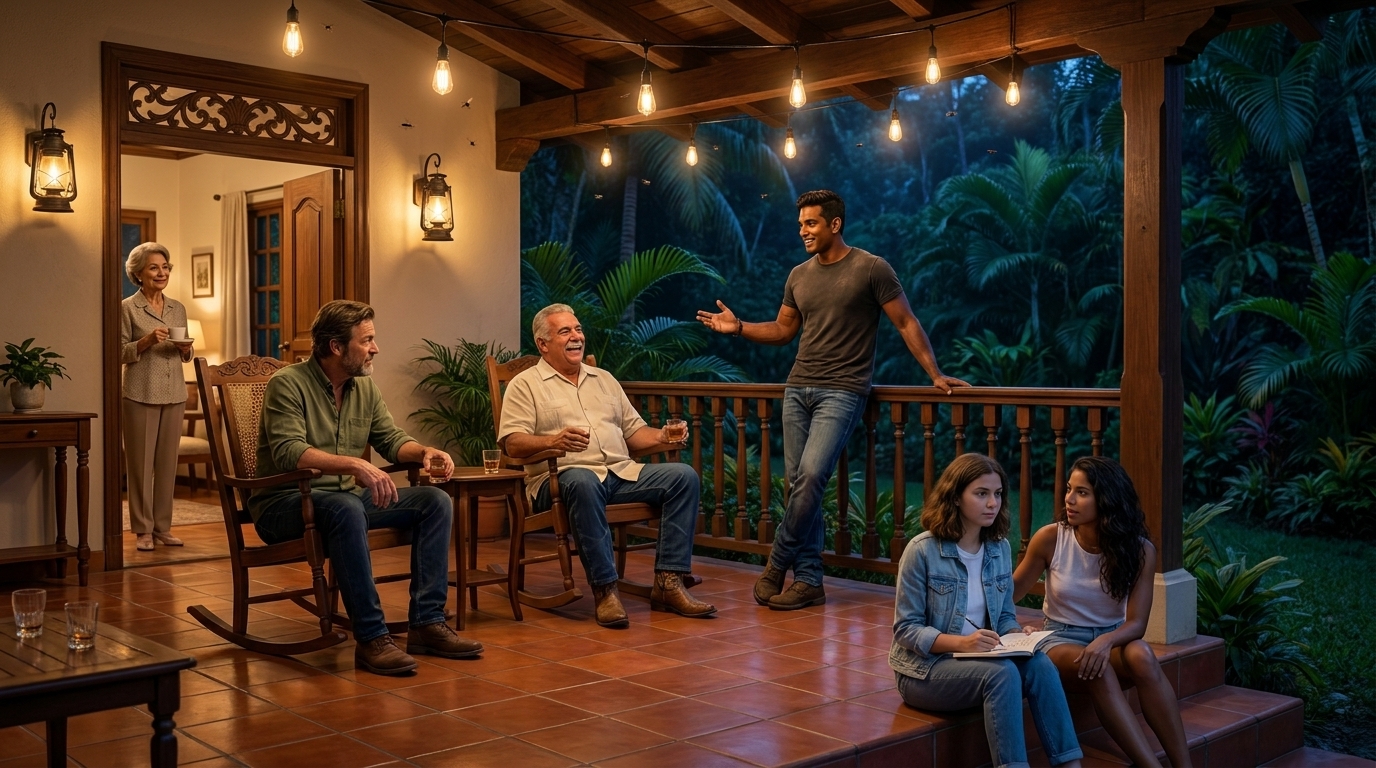
The men moved to the veranda with aguardiente. Doña Carmen brought me café con leche and a small plate of cocadas — coconut sweets, round, dense, golden — and sat with us for a while before going inside to manage something in the house that apparently needed managing. The evening sounds came in from the garden: insects, a frog somewhere, a distant dog.
Mateo had a story about a horse and a cattle gate and a series of decisions that had been wrong in sequence, each one more wrong than the last, which ended with him in a creek up to his waist and the horse on the wrong side of the fence looking at him with what he described as educada desaprobación — polite disapproval. Don Ricardo interjected corrections twice. Papa laughed. I understood enough to laugh at the right moment and Mateo pointed at me and said: “She’s got it. She already has the Spanish.”
I did not have the Spanish. I had the timing.
“You wrote in your notebook,” Valentina said, quietly, beside me. Not a question.
“I always write.”
“What did you write?”
I thought about it. “Who poured the water.”
She was quiet for a moment. Then: “What did you notice about them? Besides that.”
I thought about Yariela’s dress. The geometric band around the hem. The way it had been neither plain nor decorative — functional, personal, its own thing entirely.
“The dress,” I said. “It wasn’t a uniform.”
“No,” Valentina said. “It’s a nagua. The traditional dress of the Ngäbe women. They make them themselves — by hand, or with a hand-crank sewing machine when they have one. Some are plainer, some are very elaborate. The geometric bands at the hem and waist, the color combinations — those are their own choices. That pattern has a name. Pintura. Or dientes — teeth. People say it represents mountains, or the ripple of a river, or the scales of a dragon.” She paused. “You can tell a lot about where a woman is from by the pattern. Yariela’s family is from Chiriquí. Western Panama. Near the border with Costa Rica.”
“That’s far,” I said.
“Four hours west of Panama City. Six from here.” She looked at her hands. “The dress itself — there is a story behind it. Before the Spanish came, Ngäbe women wore very little. The missionaries arrived in the early 1600s and gave them long dresses to cover themselves. Modesty. The church’s modesty, not theirs.” She paused. “And then something happened that I find interesting, if you think about it. The Ngäbe women took this thing that was imposed on them and made it their own. They started adding the geometric patterns — the pintura. The embroidery at the hem. The colors. Over generations it became something that belongs to them entirely. You see a nagua today and you are not seeing a missionary’s idea of modesty. You are seeing four hundred years of Ngäbe women deciding what it means.”
I thought about that for a moment. Yariela’s wine-red dress with the geometric hem. Someone’s grandmother had sewn that pattern. Someone’s great-grandmother. All the way back to a moment when someone had received a plain, foreign dress and picked up a needle.
“And they come here,” I said.
She looked at her hands. “Many Ngäbe women come to work in Panama City, in the provinces, as domestic workers. It has been happening for generations — longer than anyone usually says. The comarca — the Ngäbe territory — is mountainous, the farming is hard, the land has been shrinking since the Spanish pushed them into the highlands. The cash economy doesn’t reach far in there. So they come. Some send money home. Some bring their children eventually. Some go back.”
“Do Yariela and Edilma live here?”
“They have a room in the house. They go home for the big holidays — Christmas, Corpus Christi.” She paused. “They are not the Emberá, not the Wounaan — those are the peoples from closer to the Darién, east of Chepo. Very different culture, very different dress. The Emberá paint their bodies for ceremony, the Wounaan are known for their basket weaving. You might see them in Panama City selling crafts on the Cinta Costera. But domestic work — live-in, long-term — that is much more common among Ngäbe women. They have been doing it long enough that there are networks: one woman finds a family, the next comes from the same village, and the next.”
“Your mother knows their names,” I said. “Their children’s names. She sends food when someone is sick.”
Valentina looked at me. “She told you that?”
“You told me. Just now.”
She was quiet. “Yes. My mother is — she is not indifferent. She is genuinely not indifferent.” A pause. “I know it is not enough.”
I didn’t know what enough would look like. I still don’t. I just knew that the gap between your mother knows their names and they sat at the table was a distance that didn’t collapse just because someone was kind.
“I don’t know enough to have an opinion,” I said.
Valentina looked at me sideways. “Yes you do.”
I let that sit.
Papa’s aguardiente glass caught the Edison light. Don Ricardo was explaining something about the rainy season and the pasture grass — the difference between August grass and September grass, and why it mattered for the horses. Papa was leaning forward, listening, forearms on his knees, with the focus he gives to things that genuinely interest him. He looked nothing like the man I had imagined during the years of distance. He looked like someone who had found, in the improbable middle of his life, a place where he knew things worth knowing and the people around him cared about the same things.
I took a photo of him, without thinking. Just his silhouette, the rocking chair, the aguardiente glass, the Edison light above him and the dark garden below. He didn’t notice.
I looked at it for a while. Then I put my phone in my pocket.
The frog in the garden was louder now. The insects orbited the lights. Somewhere in the dark beyond the garden the forest started — not far from here. Everywhere in this country, not far from here, the forest started.
“Mateo’s taking us to the beach on Saturday,” I said.
“Yes,” Valentina said. “He announced it. That is how it becomes true.”
“Is that how things work in your family?”
She considered. “My father decides by announcing what is already decided. My mother decides by making you believe it was your idea. Mateo announces and then makes it happen by willpower.” She paused. “I negotiate.”
“Which one works best?”
“Depends what you’re trying to do.” She looked at me. “What do you do?”
I thought about it. Texts with Mama. Report cards. The conversation in the hallway outside the hospital in April when I told Papa I wanted to come to Panama and I already had the schedule in my hand.
“I come prepared,” I said.
Valentina smiled. The real one — not the polite version but the quick, private one. “Ja,” she said, in her only German word, the one she had picked up from somewhere and deployed at the right moment every time. “That I can see.”
🎭 This Week's Episodes
Telenovelas show what we can't say in client meetings. The drama is heightened, but the patterns are real.
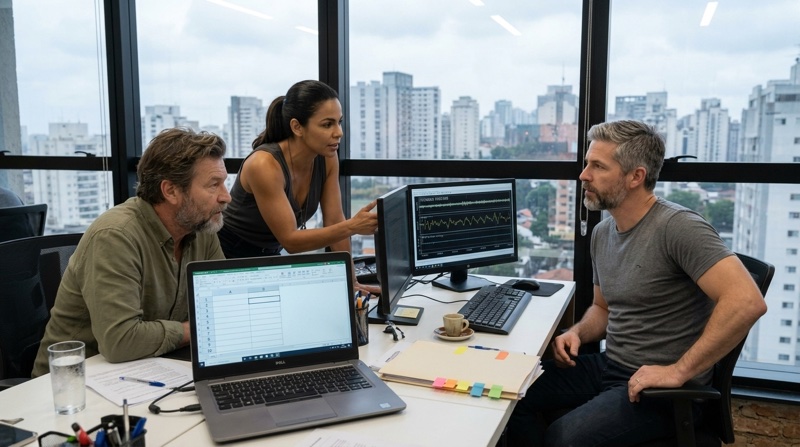 Documentation Avalanche
The forty-seven questions from Passau become a daily occupation. Stefan finds a gap the navigation team cannot investigate without Marcus's approva...
Technical Consultancy
Embedded Delivery Partner
Embedded into your team as an active contributor, reducing delivery friction and helping important work move cleanly.
Technical Advisor
Peer-style technical assessments before far-reaching decisions; reduce architectural and product risk early.
Product & Delivery
Ship working software to real users earlier. Measure impact and adapt based on evidence rather than assumption.
Custom Software Development
High quality, maintainable software. Short-term augmentation that leaves lasting capability in your own team.
Recent Articles
- What the Last 20% of an AI-Built SaaS Looks Like (17.10.2026)
- AI Computer Use Is Not a Business Contract (09.10.2026)
- When Everything Is Finally Under Control (05.10.2026)
- AI Makes Technical Execution Cheap. Judgment Stays Scarce. (26.09.2026)
- The Agent Escaped. Who Left the Door Open? (24.09.2026)